Reflections on Carter’s Book Launch Workshop: Relating to People Living with Dementia as Equals

In our second post for Dementia Action Week 2026, Matilda Carter reflects on the interdisciplinary workshop held last week on her book, Relating to People Living with Dementia as Equals: Towards Social Justice in Dementia Care (Cambridge University Press).
 Matilda Carter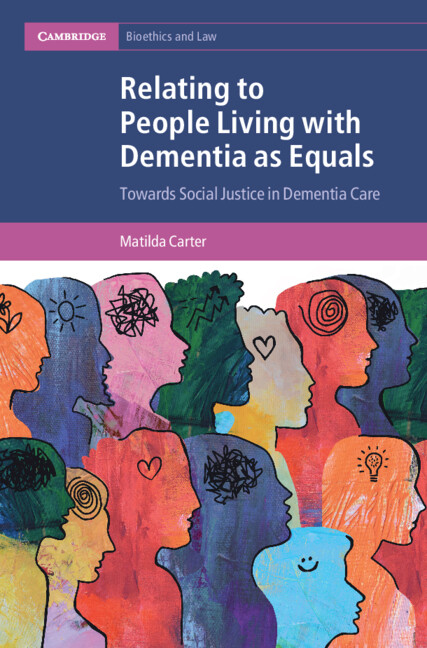
Last Thursday the 14th of May, I had the immense pleasure of hosting a workshop to celebrate the launch of my monograph, Relating to People Living with Dementia as Equals: Towards Social Justice in Dementia Care (Cambridge University Press). Having emerged out of my PhD thesis, which itself emerged out of my decade-long career in social care, I felt so moved to hear thoughtful (and often challenging) takes on a book whose contents I have been thinking about for the best part of two decades. The social care crisis is an urgent public policy challenge, and the injustices that take place in present-day dementia care are at its heart. I am grateful to all those who attended and spoke at the workshop for dedicating their time and attention to thinking through these problems with me, in so doing making me even more certain that ethics and other branches of applied philosophy have a vital role to play in building the fair and just social care sector that its users deserve.
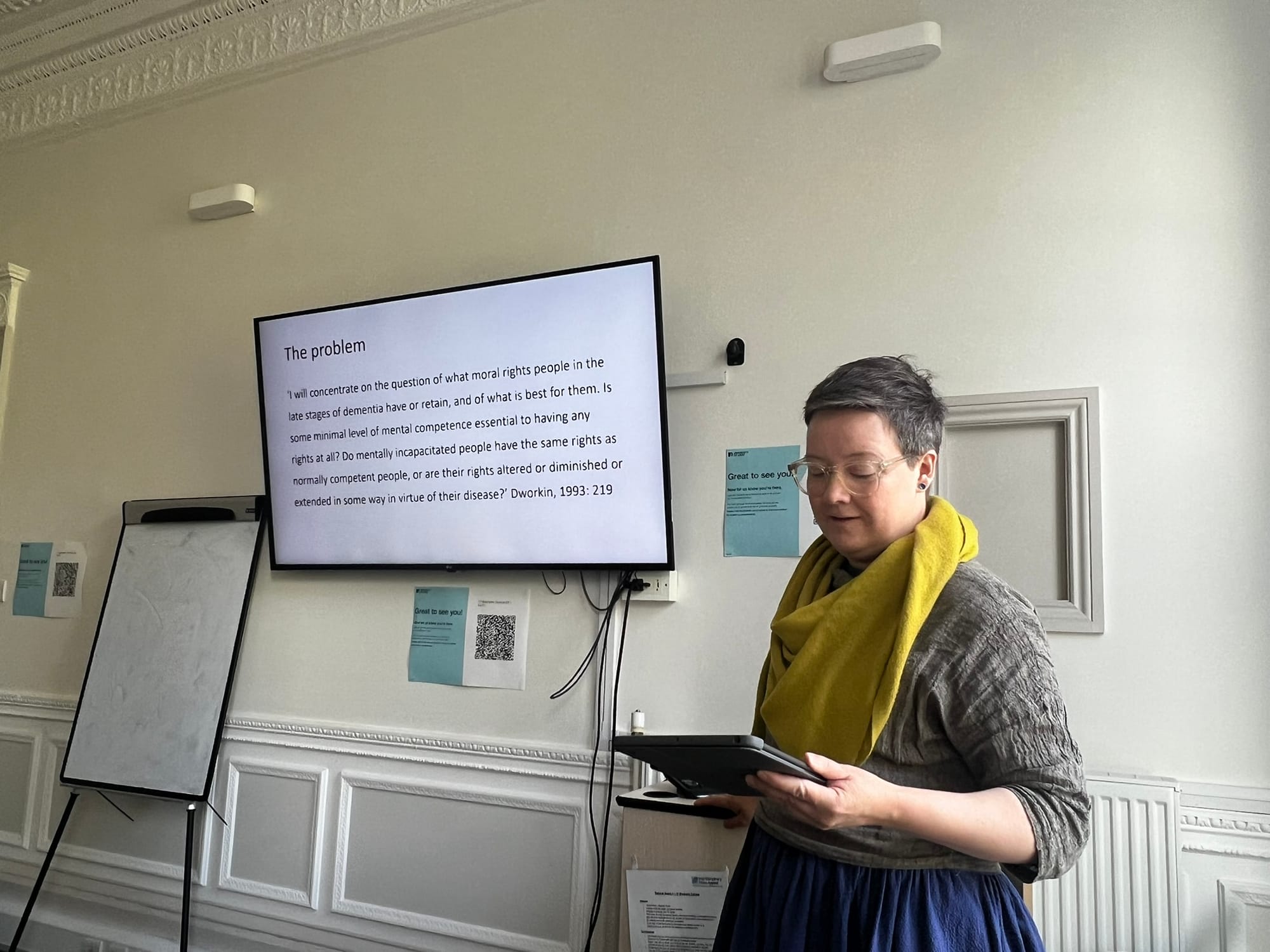
The workshop began with a talk from my IDEA colleague Danielle Bromwich. In co-authorship with Joseph Millum, Bromwich has herself recently published a book: The Ethics of Consent (Routledge), and her talk focused on the many ways our projects overlap. As she pointed out, we come to the same conclusion in the much-discussed case of Margo: a woman living with Alzheimer’s disease described in a case report by Andrew Firlik and later adopted in an argument about the binding power of advance directives by Ronald Dworkin. We both think that Margo, described by Firlik as among the most happy people he had ever met, should not be held to any preference to having life-sustaining treatment withheld that she may have expressed in an advance directive written before the onset of her dementia – we both think, that is, that she should not be left to die because of a preference that she seems no longer to hold.
Where we differ is in our route towards this conclusion. For Bromwich and Millum, this is a case that illustrates the separable grounds of consent: Margo is capable of valuing, meaning she has a right to consent, but she is not capable of taking responsibility for her actions, meaning she does not have a right against paternalistic interference. For me, this is a case that illustrates the power held by substitute decisionmakers and the risk of domination that is present when that power is not restrained.
Bromwich ended with a number of questions for me, aimed at ascertaining how far our views diverge and pressing me on areas in which she was less convinced by my argument. A key theme that emerged in our exchanges was the centrality of authenticity to my view: I argue in the book that the capacity to live authentically – that is, in accordance with values from which we would not be alienated upon reflection in a variety of circumstances – grounds Margo’s claim to be protected from interference that does not track her interests. Bromwich worried that this was a less stable foundation than the capacity to value and wondered what would happen were Margo to lose it. This was such a useful objection for helping me to clarify my argument: that the capacity to live authentically is dependent on relations, not (primarily) on internal capacities, and that I am not convinced that it is the sort of capacity that can be lost through the progression of dementia. It may be that Margo will eventually have a smaller set of authentic interests to which substitute decisionmakers ought to defer, but as long as she retains a unique subjectivity and affective relations with others, this central capacity remains.
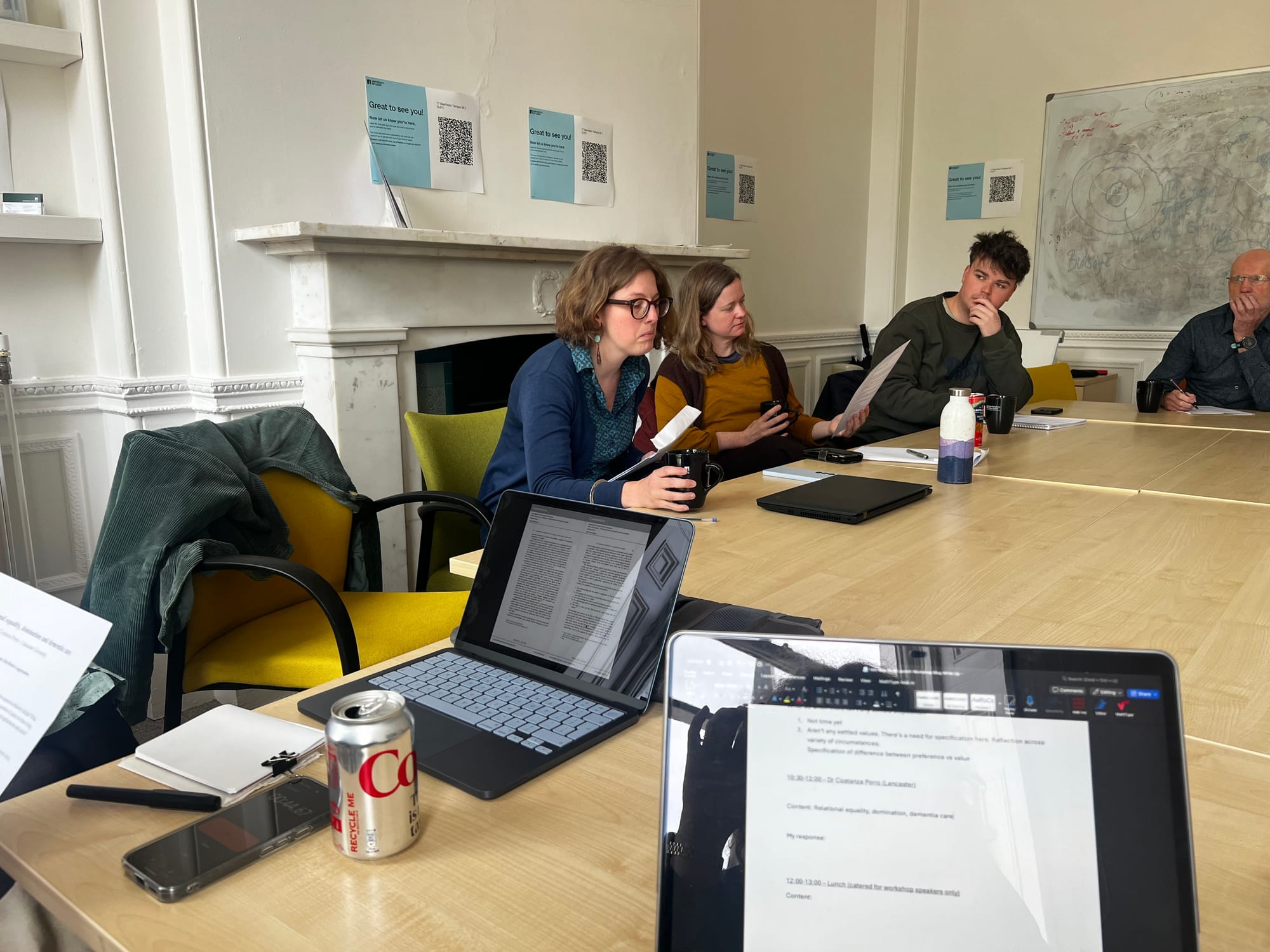
Next, Costanza Porro from Lancaster University gave a talk on the relationship between equality, justice, and care, with a focus on an, admittedly, provocative argument I make in the book about the role of informal carers in the just dementia care settlement. Reflecting on the depth of skills and training that I argue are needed for effective, just, non-dominating dementia care interventions, alongside the oversight needed to robustly guarantee they will be delivered, I invert a widespread moral intuition: that professional dementia care should only be accessed as a last resort. Instead, I make the case that well-funded, well-regulated dementia care services staffed by well-trained carers are what justice demands and, in ideal circumstances, it may even be necessary to prohibit loved ones from taking on the role of primary carer, given greater risks of injustice involved.
Porro was particularly unconvinced by my claim that a barrier between one’s intimate needs and one’s social circle is necessary to avoid marginalisation, pointing out that we might think it would better if we challenged taboos about dependency and bodily functions, rather than taking them as given, such that we ought to protect people living with dementia from being rendered mere dependents. The crux of this line of critique, I took it, was that I seemed to be unusually committed to independence, especially given my focus on ideal circumstances. What emerged from our exchanges on this was a need for me to further develop these ideas in future work. I remain concerned that an inability to negotiate the relevant aspects of one’s social identity in the most intimate circle of one’s social life carries severe risks of marginalisation. Nevertheless, Porro’s talk was really useful in illustrating the need for me to revisit and bolster this argument.
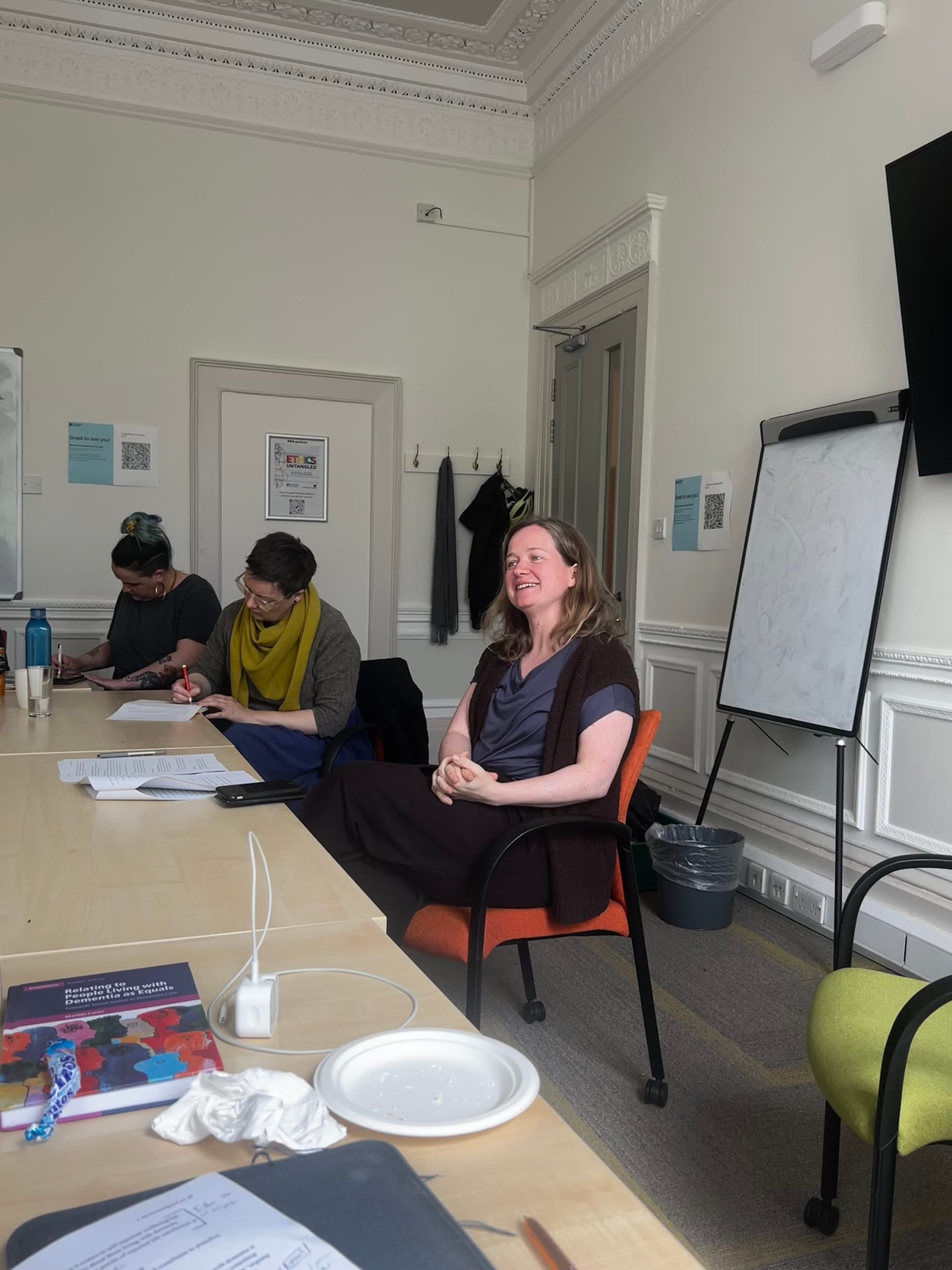
The next speaker at the conference was Emily McTernan from University College London (who, incidentally, has written about the importance of being able to negotiate social identity in the context of taking offence). Alongside Jeffrey Howard, McTernan supervised me as a PhD student, so she gave her talk from a position of great insight into how my arguments had developed over time and in-depth knowledge of the contents of the book. Her key focus was my adoption of a mere difference approach to dementia – an approach, that is, that views dementia as neutral with respect to welfare – and my rejection of a tragedy narrative about the condition.
In the talk, McTernan advanced two key claims: that (i) dementia is not a mere difference and that (ii) to say so is no more stigmatising than my own approach, meaning there is no strong pragmatic case for pretending it is. As with Porro’s talk, McTernan here put pressure on some of the most contentious claims I make in the book, and the exchanges that resulted helped me to get a clearer sense of why I thought they were so important to make. The mere difference approach to dementia I adopt in the book is rooted in the work of Elizabeth Barnes, who develops a mere difference approach to physical disability in her influential 2016 monograph The Minority Body: a Theory of Disability (Oxford University Press). I had assumed that I had diverged from Barnes’s account in two areas: I expanded it to cover all forms of disability and did not commit to a distinction between disability and illness. In my discussions with McTernan, however, I realised that my version of the mere difference approach is also distinctly methodological: it is grounded in the claim that it is stigmatising to assume a disability, like dementia, is bad for any person, with any values, in any context before we’ve even spoken to them and heard their testimony. This is something I now intend to develop in future work.
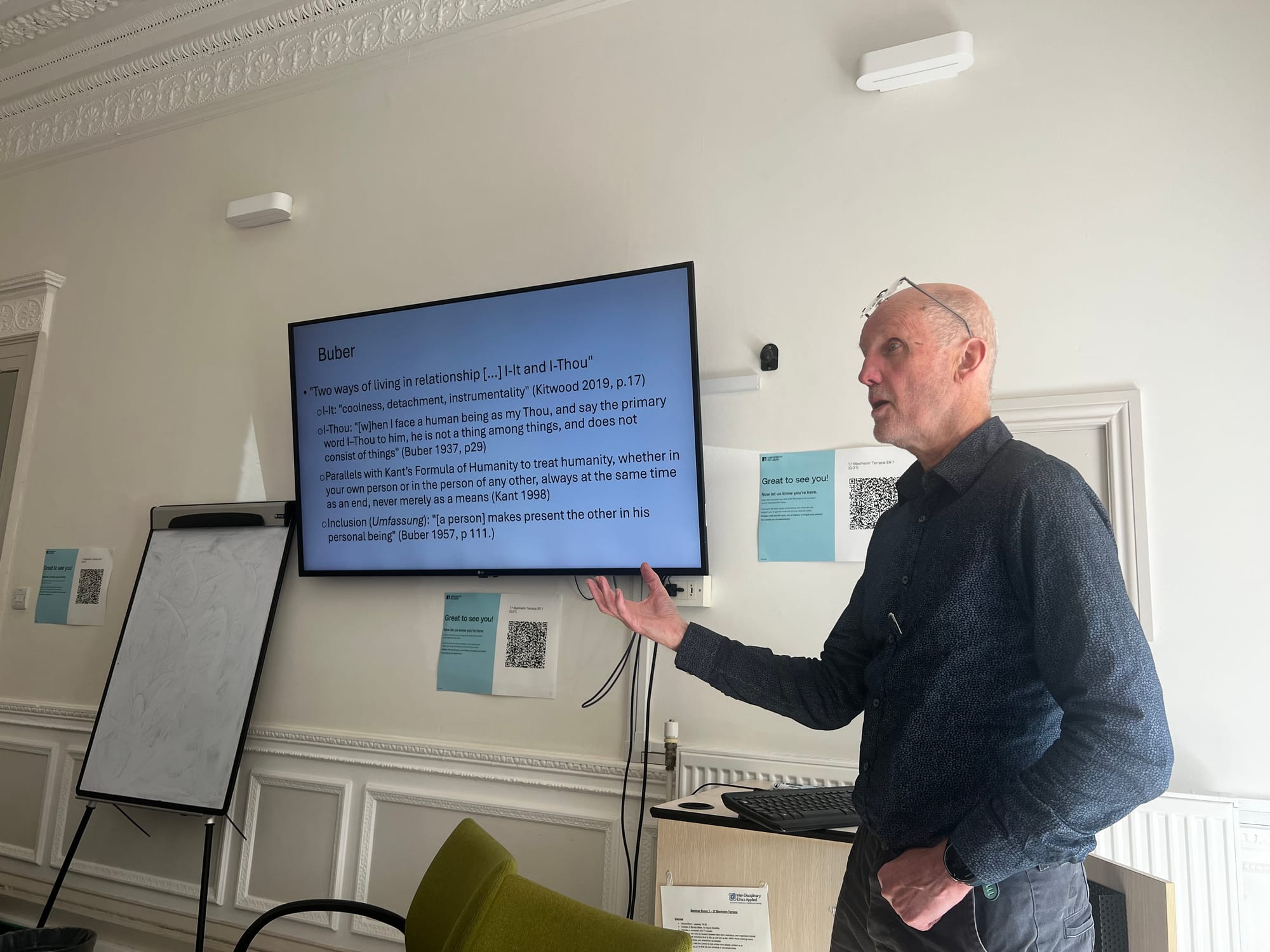
The final talk of the workshop was delivered by Andrew Stanners, a member of teaching staff at the IDEA Centre and a Consultant Geriatrician with Mid Yorkshire Teaching NHS Trust. Stanners gave a thoughtful response to my arguments in favour of an indirect-first approach to dementia care – an approach aimed at putting people living with a dementia in a position to meet their own needs, wherever possible, before intervening directly. I was pleased to hear that he saw it as relevant and useful for his practice, and that he broadly agreed with the theoretical framework. His substantive contribution was to examine the indirect-first approach from the point of view of the carer, considering what qualities would be necessary for them to enact it successfully. Drawing a line from Martin Buber, through Carl Rogers, to Tom Kitwood, Stanners situated the indirect-first approach as a practice which shares many requirements for success with psychotherapeutic interventions, including empathetic understanding, unconditional positive regard, and person-centredness.
This practice-focused talk provided a vital shift in focus as the workshop drew to a close. As a piece of engaged philosophy, I have aspired in this book to both make a substantial philosophical contribution and provide a framework that can guide social care practice and influence the development of public policy. It was fantastic to hear that reading the book had been useful for someone directly providing medical care for people living with dementia, but it was also so valuable to get a sense of the additional work that would be needed to implement my recommendations in health and social care settings. In future research, I intend to work collaboratively with non-academic stakeholders in mapping the moral landscape of social care and in developing practical ethical guidance; listening to Stanners’s talk was so rewarding for me, therefore, because it made plain both the opportunities of and the challenges posed by this kind of work.
Matilda discusses her book in more depth on the Ethics Untangled Podcast and in an interview on this blog with Luke Brunning.

