Deciding how best to care for people with dementia
In our final post for Dementia Action Week 2026, Dr Andrew Stanners reflects on Matilda Carter’s work to consider how we could best care for people with dementia. Andrew is a consultant physician for older people at Mid Yorkshire Teaching NHS Trust. Alongside his medical career, he completed a PhD at IDEA on assisted suicide and is an honorary fellow of the centre.
All people who have symptoms of dementia will need some form of care, so it’s important to come to a view on how this should best be delivered. The fifth chapter of Matilda Carter’s Relating to People Living with Dementia as Equals (2025) defends an “indirect-first” approach to care.
In this post, I’ll outline her argument and then follow her lead into a theoretical underpinning of essential capacities of dementia carers. In brief, Carter maintains that indirect care is just (under relational egalitarianism, the key theory for the book) because it is non-dominating of its recipients. It also contrasts with the many potential injustices in direct care. Non-domination of care recipients depends on being able to identify their authentic interests so that care may track these. Carter offers a suggestion that carers are trained in the skills that counsellors and psychotherapists use in order to avoid “non-interest tracking interventions” (p 116). I respond to this cue by giving an account of the origins of these skills in Martin Buber and Carl Rogers which were then applied directly to dementia care by Tom Kitwood.
Importantly, throughout the book, Carter starts each chapter with an epigraph from a person living with dementia. She does so as part of a strategy to mitigate the problem of “speaking for others” (Linda Alcoff 1991). Christine Bryden, who is living with dementia, says “[i]f you take over our lives, then it is so easy for us to withdraw into helplessness.” (p.89) Indirect care is explicitly aimed at not taking over people’s lives.
Carter then motivates the chapter with an account of the neglectful care in hospital of John Haughey who was living with dementia and died after drinking a bottle of hand sanitiser (2017). The hospital responded to this tragedy with an indirect approach—by redesigning the ward, thereby restricting access to sanitiser. This contrasted with a more direct and potentially demeaning reliance on staff swiping sanitiser away from patients. She then follows with a working definition of dementia care— “[w]here a person living with dementia is situated as a charge in a relationship with a dependency worker who directs their energies towards them to meet vital needs they either cannot meet alone or can only do so with extraordinary effort, they are in receipt of dementia care.” (p. 94) It can be seen here that dementia care entails an asymmetry of power with a consequent risk of domination.
The “Indirect-first approach” however is non dominating since the "carer is compelled […] to track the interests of the person for whom they are caring." Shaping this type of care requires "a substantial degree of individual tailoring", but Carter is optimistic that such care is possible "in light of the common symptomatic profile of dementia.” (p. 94) I will return to the latter two ideas when I discuss essential capacities of carers.
It is instructive here to return to Bryden’s fear and outline the many potential pitfalls in direct care identified by Carter. It risks accelerating the loss of capacities inherent in dementia, decreases control over the care relationship and decreases the ability to develop and express wider interests. However, most people with dementia will at some point need direct care to meet their needs, so the interface between indirect and direct care needs skilful navigation.
Carter illustrates the preferability of indirect over direct care through a hypothetical scenario of two brothers, Barry and Luke. Luke has visited Barry and finds him unshaven, wearing dirty clothes and with expired food and a gas cooker that has been left on. Barry has retired from teaching but says that his job is “tiresome”. This misconception is termed by Carter as a “parallel subjectivity”, and she identifies it alongside dependency and decline as creating a vulnerability to abuses of power.
For example, if care is direct and "fast-paced" then it may be harder for Barry to make his interests known. Interventions, such as shopping, may also be made without him being present. In general, he would not have chosen to become more dependent on others and direct care may undermine maintenance of his effective capacities. Furthermore, direct interventions may reduce his capacity to evaluate care and care relationship over time and communicate this in order, for example, to complain (p. 96).
In line with recommendations from disability theorists, Carter suggests that societal reorganisation can be a better way to address unmet needs (p 98). So for Barry these could entail assistive technologies such as Andy Clark’s "cognitive scaffolding" in the form of “notes, labels and schedules”. The home environment could be reorganised to make life easier. This may "constrain [carers'] power while greatly improving the ability of those like Barry to live according to their own authentic values." (p. 100)
Alongside cognitive scaffolding, interpretation of parallel subjectivity is an important second component of indirect care (p. 100). Kitwood (in Carter) says "statements grounded in such misconceptions are attempts to communicate real needs” and these needs may go unmet if the carer doesn’t meet them in a way that makes sense from the person with dementia’s point of view. So “[a] carer must be able to identify what is being expressed and interpret the world in a way that is comprehensible” (p. 101).
Space doesn’t permit me to discuss Carter’s responses to objections on the grounds of deception, paternalism and stigma or to cover the necessary oversight of carers and how this itself could be seen as dominating to them. For these, please read the book! I will now move to my own response to the chapter which addresses first, the heterogeneity of people and dementia itself, second, the complexity of scaffolding and interpretation and last, essential person-centred capacities of carers with some theoretical underpinnings.
As Carter states, people with dementia have many symptoms in common including impaired memory and planning, disorientation and an inevitable progression. However, they are clearly all unique people with their own subjectivities (p. 60). There are also some differences between subtypes of dementia such as sudden changes and mobility/walking issues with vascular dementia (15% of all dementia), fluctuating alertness, visual hallucinations and disordered sleep in Lewy-body dementia (10%) and personality changes, deterioration in social skills and language difficulties in frontotemporal dementia (2%) (Alzheimer’s Research UK). All the features above will complicate a carer’s assessment of any particular person, for example in identifying their authentic interests in order to track them.
Furthermore, there are features of care itself that may complicate the picture. Indirect care may itself be dominating if incorrectly shaped. As mentioned above, scaffolding requires sophisticated tailoring. Interpretation is also complex so there may be a need for sensitive trial and error. Indirect care will at times coexist with direct care and will normally in time be replaced by direct care. All these aspects of care place significant demands on already under resourced and undervalued care workers. Carter suggests they may need societal investment and “training in the kind of therapeutic questioning skills counsellors and psychotherapists possess [in order to] ensure [they] can effectively interpret parallel subjectivities and avoid non-interest tracking interventions.” (p. 116)
In the following I outline one tradition in those skills starting with Buber and Rogers and finishing with Kitwood who worked specifically in the field of dementia.
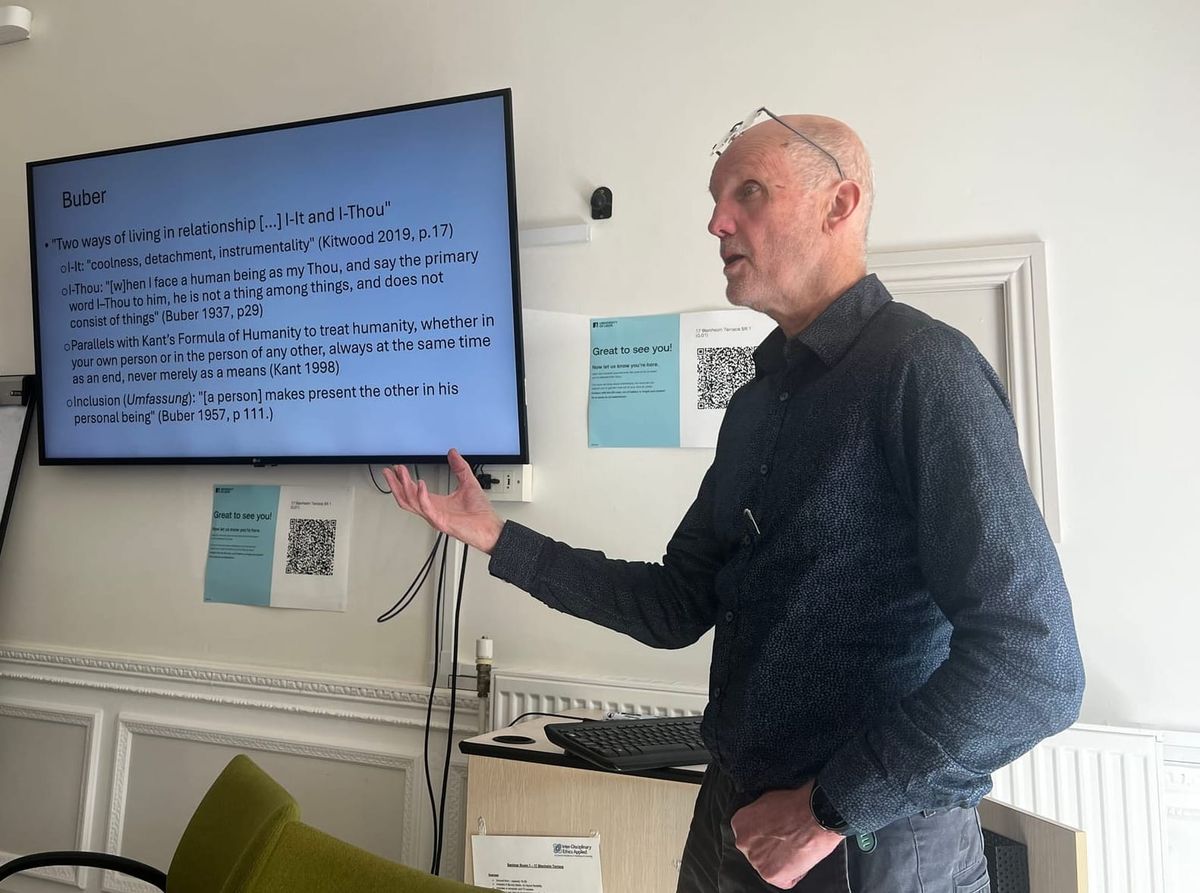
In Buber’s key work I and Thou (Ich und Du, 1923), he describes "[t]wo ways of living in relationship […] I-It and I-Thou" (Kitwood 2019, p.17). People may see parallels in this idea with Kant’s Formula of Humanity to treat people as an end and never merely as a means (Kant 1998, p 37). I-It implies "coolness, detachment, instrumentality" (Kitwood 2019, p.17), whereas Buber says of I-Thou that "[w]hen I face a human being as my Thou, and say the primary word I–Thou to him, he is not a thing among things, and does not consist of things" (Buber 1937, p. 29). His concept of “inclusion” (Umfassung) is fundamental to I-Thou; I-Thou depends on a person “mak[ing] present the other in his personal being" (Buber 1957, p. 111.) Under Inclusion, the I empathises with the Thou whilst maintaining their own perspective. This is a special type of relating to another person which informed Roger’s foundational work in person-centred psychotherapy and which, importantly for our purposes, can be seen potentially to offer access to a person’s authentic interests.
Rogers' six conditions for Therapeutic Personality Change (1957) are as follows: the people have psychological contact—so each is aware of the other, the client is vulnerable or anxious, the therapist is integrated in the relationship, the therapist experiences Unconditional Positive Regard (UPR) for the client—this can be seen as "warm acceptance" or "prizing", the therapist experiences an empathetic understanding and communicates this—they "sense the client's private world as if it were [their] own" and last, the therapist’s communication to the client of their empathy and UPR is achieved. All the skills necessary for this type of interaction are acquired through "experiential training"
Kitwood, who had a background in psychology and psychotherapy, became aware of prevailing discounting and demeaning attitudes to people with dementia and saw them as part of a "malignant social psychology". His response to this was to identify twelve types of positive interaction from which I highlight six (2019, p 89). These are: recognition—"careful listening over a period", negotiation—people are "consulted about their preferences desires and needs" which "puts power back into their hands", collaboration—"process in which their own initiative and abilities are involved", validation—"a high degree of empathy, attempting to understand a person's entire frame of reference" and holding—providing "a safe psychological space" from which the carer is not driven away. He said that "good care requires a very highly developed person: one who is open, flexible, creative, compassionate, responsive, inwardly at ease." (2019, p117-8). These are the skills that care workers need in order to provide the best, indirect and thereby non-dominating care to people living with dementia.
I have outlined Carter’s argument for an indirect-first approach as a just, interest-tracking way to provide dementia care. I suggest, following her cue, that satisfactory provision of indirect-first care is conditional on the capacities of the dependency workers who provide it. These capacities, as described by Kitwood, should draw on the person-centred psychotherapeutic tradition.