Welcome to Ethics Untangled
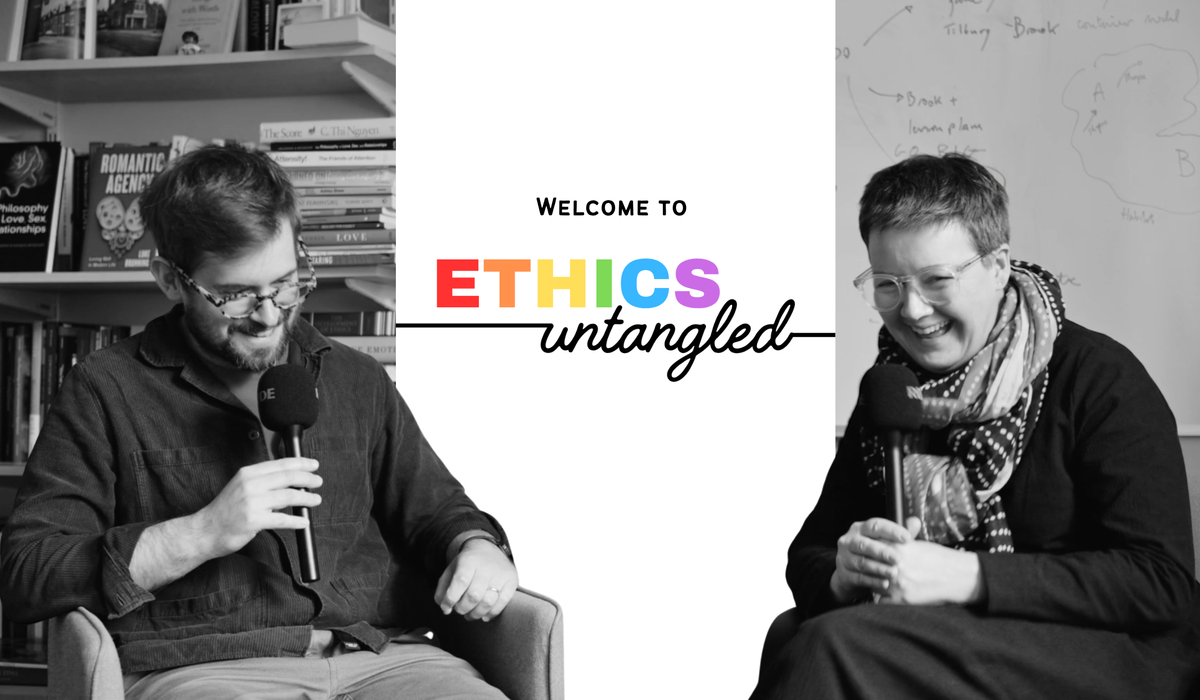
A space for us to engage with everyday ethics.
Luke Brunning and Danielle Bromwich, the editors of Ethics Untangled, introduce us to this new blog, chat about the distinctive culture at IDEA: The Ethics Centre at the University of Leeds, and talk through their desire to build a community committed to practically engaged applied ethics.
Subscribe if you'd like to stay up to date and receive emails when new content is published.
What's IDEA: The Ethics Centre?
Luke Brunning: We're here to introduce the IDEA centre’s new blog, Ethics Untangled. So, Danielle, can you tell me a little bit about what the IDEA centre actually is?
Danielle Bromwich: Yeah, it's a centre in the School of Philosophy, Religion, and History of Science here at Leeds University. We are a group of practically engaged philosophers working on applied ethics. We have post-grads, post-docs, and various academics working on a whole host of issues in applied ethics, such as AI ethics, sexual ethics, bioethics, climate ethics, and so on.
We're also very distinctive in that we have a consultancy and training division. IDEA colleagues work with professional organisations, like The Law Society, the Banking Standards Board, the Royal Institute of Chartered Surveyors, and the Online Dating and Discovery Association. This work is varied, covering leadership ethics, devising codes of ethical practice, and creating training materials. What else am I missing?
LB: Okay, so is there basically anything we don't do? I mean, it sounds like all of applied ethics is pretty much covered, right?
DB: That's right. In fact, the other thing we do is all of the teaching with partner schools at Leeds where students require ethics training. We have designed, led, and teach ethics in the medical school, dentistry, engineering, management, business...
LB: ...even theatre!
DB: Yeah, even theatre!
LB: Okay, so you're right. So we've got ethical teaching all over the university, consultancy, and obviously people are researching. Can you just remind us of a few highlights of that research community? What people are doing? What the graduate students are doing, post-docs, and so on?
DB: Lots of exciting stuff. We've got a lot of people working with you and Tash McKeever on the ethics of online dating, we've got a fabulous PhD student working on consensual non-consensual sex, and folks working on aromanticism and asexuality. We've also got a new colleague here working on dementia and social care, and their work has sparked a more general interest in practically engaged work on social care and healthcare ethics. There's a lot of interesting stuff going on.
LB: Yeah. And can I ask what your own research specialism is?
DB: I primarily work on consent. So, at the moment, I'm working on a novel conception of decision-making capacity for consent. How about you?
LB: Me? Well, sexual ethics, intimacy, philosophy of emotion, the messy bits of life as applied to philosophy, really. But yeah, you're right. So we have lots of people doing research across all areas of applied philosophy. From body disposal to AI, climate change, political activism, the problem of dirty hands, and the ethics of forgiveness. It's all going on here.
What makes IDEA distinctive?
LB: Can you say a bit more, though, about like why the IDEA centre is probably distinctive amongst applied ethics centres in the UK?
DB: I think one of the things that makes us really distinctive is that we have a lot of people who work with professionals, people in industry, as well as the general public. A lot of the work that we do comes from the ground up. It comes from areas in which people confront ethical issues in their everyday life and want to reflect on them, want to consult with us, want us to create training materials or offer advice. We are really doing practically engaged, two-way philosophy.
Although much of our work comes from conversations we have with colleagues or engaging with debates in the academic literature, much of it also comes from our engagement with those outside the academy – conversations with people who are interested in questions that philosophers, I think, are well equipped to answer or at least help them think through.
LB: And so this idea of two-way philosophy is really important?
DB: It is. One of the reasons we're setting up this blog is to connect with diverse audiences. We want to do even more of this two-way philosophy.
LB: But by two-way, you mean that we're also listening and learning from them?
DB: Yeah, listening, learning, collaborating. This is something we do at IDEA. Our events are almost always interdisciplinary, inclusive of people in industry and outside the academy. We have, through our consultancy work and research, engaged in a lot of really rich collaboration. We want to do more.
Why should you subscribe to Ethics Untangled?
DB: Okay, Luke, let's talk about this blog we're starting, Ethics Untangled. Why should people be interested? Why should they subscribe? Why do you think we need it?
LB: I think we need it for a range of reasons. So one avenue through which we try and connect with people is through social media, but that limits you in what you can actually do. So longer-form writing, interviews, things like this that we're doing right now are a bit harder to put on social media. But also we're hoping to reach new audiences, so we want to engage with people that are writing, thinking, perhaps from industry, other students, prospective students, people thinking about ways in which thought more generally can help us address some of these ethical problems. And I think branching out to new platforms will help us with that.
It's also a wonderful platform for the entire breadth of our community. So not just academic staff here, but post-docs and visiting fellows and our PhD students. There's a whole host of people that are thinking about these issues and producing content around them asking important questions and we want a place to put it all – a rolling zine online, if you will.
DB: What's the relationship to the podcast, because we also have a podcast called Ethics Untangled?
LB: We do. So, Jim Baxter has been running Ethics Untangled, the podcast – a fantastic resource where philosophers, for the most part, discuss applied ethical topics of the time. And these topics have ranged vastly from, obviously, the ubiquitous worries about AI, to things like drill music or climate, or relationship anarchy, things like that. And so the two are going to be working in tandem. We'll be drawing attention to the podcast, but our main goal is to look beyond that to find new ways of engaging with people, exploring different kinds of writing. So, people talking about their research, people engaging with current affairs, people describing events that are going on, both before and after reflecting on those events, and also just engaging with each other in a slightly kind of slower, more nuanced way. We will favour longer interviews, more spaces to ask people about their books that they're writing, or the papers that they've published, and generally just give everyone a deeper flavour of what's actually happening in the IDEA centre.
DB: It's going to be a really nice place to showcase people's work, as well as make connections.
I find this happens all the time – you start chatting to a colleague here, or someone at one of our many events, and you find out that they are working with a group you're interested in connecting with or they have an interest you share but didn't know about (like the aro/ace research network). One of the challenges of working at such a large and lively place is that you can just as easily miss connections as you can make them! My hope is that this blog acts as a record of all of our work, interests, and networks, thereby forging more collaboration and conversation.
What will make Ethics Untangled distinctive?
DB: Okay, final question. What do you think will make Ethics Untangled distinctive from all the other blogs or offerings out there?
LB: Well, it's early days, but I think the goal will be to emphasise a degree of nuance and change of pace and also to make this really open and broad in its reach. So we're not really limiting ourselves to one area of applied ethics. We're not trying to engage with only a certain number of topics in the media. We really want to give people a flavour of the range of philosophy, the different topics that our students are working on, looking at communicating philosophy and asking questions and listening to the wider public in lots of different ways.
Listening is really important here. What we're looking for is to deepen our existing collaborations, but hopefully to build nuance and find new connections, ways of meeting contemporary social problems with other people, ways of sharing resources and reaching out beyond the university.
DB: This is yet another distinctive feature of IDEA, right? Our commitment to practical engagement outside the academy has motivated many of us to do rigorous but accessible work. We're used to having conversations, writing thought pieces, and generally communicating clearly, cutting to the chase, connecting philosophy to practice and vice versa. I hope we can showcase that on the blog, too.
LB: Me too. And also, to be honest, it's a good place for people to practice doing that. So for new PhD students it's a wonderful opportunity to try and communicate their research in a format that's accessible and interesting, receive feedback, listen to people's questions, connect with other people writing in a similar way, and generally participate in this broader emerging ecosystem that we're seeing at the moment where thinkers of all different kinds are connecting online, sharing ideas, forging connections.
The university is changing, more generally. People are hungry for analysis, they're hungry for ethical thinking. I mean, we just look around the world today, we see it's a troubling place. A lot of major issues that we need to work on. These issues will only be addressed collaboratively and trying to find platforms that facilitate that is going to be really important.